Good Late Morning:
For the last few days, our weather group ("Israel Winter Weather") has been discussing model forecast differences between the GFS (American model) and the ECMWF (European Model). Both are forecasting a rather significant storm to affect our area Friday into Sunday, with heavy rain, strong winds, and thunderstorms. Both are forecasting this storm to dive to our west, south of Crete. This means that the cold air originally associated with the storm will moderately warm as it heads our way over the Mediterranean Sea. Hence, even though temperatures in the lower atmosphere (850 mb) will be close to zero at the higher elevations, only snow mixed with rain is possible (but not likely).
The model differences concern the positioning of the next weather system to follow next week. The ECMWF has the storm moving in from our north while the GFS had the storm again taking a more westerly track. Each of these models were generally supported by their ensemble counterparts.
Our group identified the forecast disparities as being due to differences in the continued development of this weekend's storm as it passes east of us. If it maintains its strength, it would help to direct the next storm further eastward to arrive more directly from the north. If not, we would have a repeat of this weekend's rain storm.
Regardless, both model indicate the possibility of another significant storm next week, but there is far from any certainty of just how cold it will get.
It's easy to just ask: "what will the weather be?" without accounting for uncertainty in our knowledge of the current state of the atmosphere (especially in far northern areas where our coldest storms originate). There is also model forecast uncertainty associated with physical algorithms that describe the land, sea, and atmosphere, as well as uncertainty associated with chaotic behavior caused by the need to solve complex non-linear equations using finite differencing on a computer that necessitates round-off error (at the limit of precision of the computer).
The result is that we can usually see several days into the future, but beyond this time frame the forecast becomes much more uncertain. In fact, the only time I remember a winter storm that was apparent in the forecasts even 10-12 days in advance was the very significant snowstorm of December 2013. In this case, the circulation patterns that led to this storm were so strong and well defined that they were resolvable by the forecasts even so far in advance.
People actually live with uncertainty in their lives all the time. We make many decisions based on hunches or optimism. However, given the chance they will seek certainty even when it will cause potentially personal harm. One such case is the decision to be vaccinated or not. The vaccine against measles, etc, is very effective and complications are very rare. (https://www.sciencedaily.com/releases/2019/03/190307131455.htm; https://www.cdc.gov/vaccines/vpd/mmr/public/index.html; (https://www.cdc.gov/vaccinesafety/vaccines/mmr-vaccine.html). Yet, around 140,000 unvaccinated children died of measles in 2018 (https://www.who.int/news-room/detail/05-12-2019-more-than-140-000-die-from-measles-as-cases-surge-worldwide). Unfortunately, there are "supposedly" reputable organizations that suggest otherwise, (https://www.globalresearch.ca/measles-vaccines-kill-more-people-than-measles-cdc-data-proves/5429736), overlooking the fact that the reason there have been relatively few deaths from measles (percentage wise) is the high rate of vaccination!
Recently, the Time of Israel noted that this flu season is especially virulent and deadly (https://www.timesofisrael.com/israel-low-on-flu-shots-as-seriously-ill-set-to-overtake-past-2-years-combined/). In fact, my father remembers his Aunt telling him about the Spanish Flu, which killed more people than those that died in World War I. Folks would get on the trolley as living beings, but be dead before they got off. One reader of the Times article commented that the strains of flu change too quickly for the vaccines to be effective, and suggested to readers that they instead get a good night sleep and eat plenty of garlic. While it is true that each year's Flu vaccine is based in part on guesswork (for which strains will be present the coming winter), important studies have documented the effectiveness of the Flu vaccine as well (https://www.cdc.gov/flu/prevent/vaccine-benefits.htm).
So, save yourself and those you will infect from being a victim of the Flu: get vaccinated!
Sincerely and Happy New Year,
Barry Lynn

Wednesday, January 1, 2020


Friday, December 27, 2019
Weather It Is (Stormy, But Then A Break)
Good Morning:
The Winter Storm rages on, although the cold is not too severe, as snow has fallen only on the Hermon. Nevertheless, the IMS reported that this storm broke single day rain records, consistent with our forecasts. There has also been large amounts of lightning and hail/graupel associated with thunderstorms invigorated by desert dust.
Prior, we spoke about a possible storm this coming Sunday or Monday. However, this storm is now forecast to move south of Crete, southward into Egypt, before moving our way later in the week. As it does so, there is the possibility that a reinforcing shot of cold air will bring a redevelopment and another cold winter storm.
By the way, both the Artic Oscillation (AO) and North Atlantic Oscillation (NAO) have become strongly positive, meaning that the coldest air is located over the artic and polar regions, where it typically was, but in the last several years was not. The AO and NAO are forecast to remain positive through January. The negative AO and negative NAO have been one manifestation of the unusually cold and snowy US winters, and rainy but relatively mild weather here. For us, this reversal opens the possibility that our winter will revert more to normal, with an occasional deep trough that could bring snow to the mountains of Jerusalem sometime this coming month.
Happy Chanukah and Shabbat Shalom,
Barry Lynn
The Winter Storm rages on, although the cold is not too severe, as snow has fallen only on the Hermon. Nevertheless, the IMS reported that this storm broke single day rain records, consistent with our forecasts. There has also been large amounts of lightning and hail/graupel associated with thunderstorms invigorated by desert dust.
Prior, we spoke about a possible storm this coming Sunday or Monday. However, this storm is now forecast to move south of Crete, southward into Egypt, before moving our way later in the week. As it does so, there is the possibility that a reinforcing shot of cold air will bring a redevelopment and another cold winter storm.
By the way, both the Artic Oscillation (AO) and North Atlantic Oscillation (NAO) have become strongly positive, meaning that the coldest air is located over the artic and polar regions, where it typically was, but in the last several years was not. The AO and NAO are forecast to remain positive through January. The negative AO and negative NAO have been one manifestation of the unusually cold and snowy US winters, and rainy but relatively mild weather here. For us, this reversal opens the possibility that our winter will revert more to normal, with an occasional deep trough that could bring snow to the mountains of Jerusalem sometime this coming month.
Happy Chanukah and Shabbat Shalom,
Barry Lynn
Tuesday, December 24, 2019
Weather It Is (Storm Warning)
Our first Winter Storm arrives today.
1) Rain is expected to arrive along the northwest coast on Wednesday, and spread to the central coastal areas during the day.
2) Heavy rain/thunderstorms are expected Wednesday afternoon and night.
3) Gale force winds Wednesday night into Thursday morning.
4) Our WRF forecast shows between 75 to 100 mm of rain in convective storms over a 6 hour period, currently forecast to be within the Tel-Aviv area late Wednesday, northward to Netanya.
5) Rain arrives in Jerusalem Wednesday night.
6) The storm continues until Friday, with rains over the south as well.
7) There is a 25% chance of snow at the end of the year.
Be Safe
Friday, December 20, 2019
Weather It Is (Winter Storm On The Way)
Good Morning:
After several Fall rains, Winter is on its way. Relatively mild winter weather will be replaced by a distinct chill as we move from Monday night into Tuesday. Moisture will be quick to follow, and so will the wet, and very windy weather (with possibly gale force winds).
The winter weather will be courtesy of a storm dropping down from western Turkey, with a reinforcing shot of cold air as we move into later this coming week. The very chilly weather should last for several days, and there is a 15% chance that temperatures will drop close to freezing in the higher elevations as we move towards the very end of the year.
As of note, most of the global ensemble forecasts are predicting 50 mm or more for the central mountains, and higher amounts along coastal areas. Expect cold temperatures aloft to also invigorate convective storms leading to periods of heavy rain, strong winds, and hail.
As we noted in our last blog, the winter weather is forecast to continue well into January.
Highlights:
1) Storm arrives Monday night.
2) Gale force winds expected.
3) Heavy rain, floods.
4) Hail, thunderstorms, and snow on the Hermon.
Barry Lynn
After several Fall rains, Winter is on its way. Relatively mild winter weather will be replaced by a distinct chill as we move from Monday night into Tuesday. Moisture will be quick to follow, and so will the wet, and very windy weather (with possibly gale force winds).
The winter weather will be courtesy of a storm dropping down from western Turkey, with a reinforcing shot of cold air as we move into later this coming week. The very chilly weather should last for several days, and there is a 15% chance that temperatures will drop close to freezing in the higher elevations as we move towards the very end of the year.
As of note, most of the global ensemble forecasts are predicting 50 mm or more for the central mountains, and higher amounts along coastal areas. Expect cold temperatures aloft to also invigorate convective storms leading to periods of heavy rain, strong winds, and hail.
As we noted in our last blog, the winter weather is forecast to continue well into January.
Highlights:
1) Storm arrives Monday night.
2) Gale force winds expected.
3) Heavy rain, floods.
4) Hail, thunderstorms, and snow on the Hermon.
Barry Lynn
Sunday, December 15, 2019
Weather It Is (Just Nice Weather)
Good Evening:
There's not much going on weatherwise around here. After a few chilly days to start our week, the winds should switch to a more southerly direction, bringing much milder weather our way.
The warm weather will be in response to a ridge of higher pressure building into our region, as a colder low pressure trough exits to our east.
At this point in time, many folks might be just ready to throw up their hands and give up on our winter. In fact, we haven't really had winter yet, and our last storm (with 90 km/h winds in Ashkelon) was more typical of fall than winter.
Yet, change might be just around the corner. You've heard of our "Israel Winter Weather" group. It is populated by a bunch of optimists, one of which is even more optimistic than the rest. One of the members is Yaakov Consor, who has contributed to this blog in the past. The other is Jonathan Hoffman (of Jerusalem Weather Forecasts: www.facebook.com/jerusalemwf). While my weather site provides detailed forecast information from various models, our group makes an effort to not leave any stone unturned that might give a reason for the group's existence.
Fortunately, there are a number of signals that next week's warmth may be this year's last, and the year will end with a period of colder and rainy weather (with snow on the Hermon). Moreover, the Artic Oscillation and North Atlantic Oscillation are forecast to both go positive and remain in their positive phase through January. This type of weather pattern implies a stormy and chillier than normal January. While we've had rainy, we haven't had chilly at the same time. If one puts rainy and chilly in the same sentence, one might have the ingredients for snow as we move into January.
As seen here (https://www.carbonbrief.org/guest-post-how-the-greenland-ice-sheet-fared-in-2019), a negative NAO has bad repercussions for the Greenland ice sheet. Too much melting of this ice sheet could detrimentally raise sea-levels. A shift to positive NAO will push storms further north into northern Europe, hopefully increasing snowfall on the ice-sheet, and building it back up to more normal levels. For us, this type of circulation pattern bends back towards the eastern Mediterranean, bringing us our rainy winter weather. If one of these storms merges with a Siberian trough, we can get a large snowfall.
I need to stop now and update you on the fate of our Snail family I am sure that you've been wondering just how they've been, since you saw them happily chomping away on an assortment of vegetables one evening a few weeks ago. Well, I can tell you that they don't all fit on one plate now, and that their numbers have grown. This is exciting news for those that like snails and are interested in their welfare. You might also like to know that sometimes snails don't get along with each other, and occasionally you'll find one snail eating by him or herself, alone. This is less likely, now, though, because there are just too many snails to be picky.
Well snails may be nice, Jelly Fish are not -- and they have ruined too many trips to the beach. We've all been bothered by the number of Jelly Fish -- who cause all sorts of problems for bathers and fish. Since there hasn't been any weather, I tried to think of some other business that might help make ends meet. As you know, I like to cook, so I thought of a recipe for Jelly Fish Pie. It's a start.
Here it is: 6 eggs (beaten), 1 cup sugar, a pinch of salt, 1 tsp Vanilla Extract, 1/2 tsp nutmeg, and 2 cups milk. Add the last ingredients together, and then beat in 1/2 cup Jelly Fish flour. Add to a pie crust, and cook for 25 to 35 minutes at 175 degrees Celcius. The Jelly Fish flour adds consistency and flavor that is unique to members of the Scyphozoa (phylum Cnidaria). However, most Rabbis do not consider gelatinous members of the subphylum Medusozoa, a major part of the phylum Cnidaria to be kosher. If you're one of those, then just make the recipe for custard pie, which can be found here: https://www.allrecipes.com/recipe/26326/elvas-custard-pie/. Just be sure to tell your guests it's not Jelly Fish Pie.
Barry Lynn
There's not much going on weatherwise around here. After a few chilly days to start our week, the winds should switch to a more southerly direction, bringing much milder weather our way.
The warm weather will be in response to a ridge of higher pressure building into our region, as a colder low pressure trough exits to our east.
At this point in time, many folks might be just ready to throw up their hands and give up on our winter. In fact, we haven't really had winter yet, and our last storm (with 90 km/h winds in Ashkelon) was more typical of fall than winter.
Yet, change might be just around the corner. You've heard of our "Israel Winter Weather" group. It is populated by a bunch of optimists, one of which is even more optimistic than the rest. One of the members is Yaakov Consor, who has contributed to this blog in the past. The other is Jonathan Hoffman (of Jerusalem Weather Forecasts: www.facebook.com/jerusalemwf). While my weather site provides detailed forecast information from various models, our group makes an effort to not leave any stone unturned that might give a reason for the group's existence.
Fortunately, there are a number of signals that next week's warmth may be this year's last, and the year will end with a period of colder and rainy weather (with snow on the Hermon). Moreover, the Artic Oscillation and North Atlantic Oscillation are forecast to both go positive and remain in their positive phase through January. This type of weather pattern implies a stormy and chillier than normal January. While we've had rainy, we haven't had chilly at the same time. If one puts rainy and chilly in the same sentence, one might have the ingredients for snow as we move into January.
As seen here (https://www.carbonbrief.org/guest-post-how-the-greenland-ice-sheet-fared-in-2019), a negative NAO has bad repercussions for the Greenland ice sheet. Too much melting of this ice sheet could detrimentally raise sea-levels. A shift to positive NAO will push storms further north into northern Europe, hopefully increasing snowfall on the ice-sheet, and building it back up to more normal levels. For us, this type of circulation pattern bends back towards the eastern Mediterranean, bringing us our rainy winter weather. If one of these storms merges with a Siberian trough, we can get a large snowfall.
I need to stop now and update you on the fate of our Snail family I am sure that you've been wondering just how they've been, since you saw them happily chomping away on an assortment of vegetables one evening a few weeks ago. Well, I can tell you that they don't all fit on one plate now, and that their numbers have grown. This is exciting news for those that like snails and are interested in their welfare. You might also like to know that sometimes snails don't get along with each other, and occasionally you'll find one snail eating by him or herself, alone. This is less likely, now, though, because there are just too many snails to be picky.
Well snails may be nice, Jelly Fish are not -- and they have ruined too many trips to the beach. We've all been bothered by the number of Jelly Fish -- who cause all sorts of problems for bathers and fish. Since there hasn't been any weather, I tried to think of some other business that might help make ends meet. As you know, I like to cook, so I thought of a recipe for Jelly Fish Pie. It's a start.
Here it is: 6 eggs (beaten), 1 cup sugar, a pinch of salt, 1 tsp Vanilla Extract, 1/2 tsp nutmeg, and 2 cups milk. Add the last ingredients together, and then beat in 1/2 cup Jelly Fish flour. Add to a pie crust, and cook for 25 to 35 minutes at 175 degrees Celcius. The Jelly Fish flour adds consistency and flavor that is unique to members of the Scyphozoa (phylum Cnidaria). However, most Rabbis do not consider gelatinous members of the subphylum Medusozoa, a major part of the phylum Cnidaria to be kosher. If you're one of those, then just make the recipe for custard pie, which can be found here: https://www.allrecipes.com/recipe/26326/elvas-custard-pie/. Just be sure to tell your guests it's not Jelly Fish Pie.
Barry Lynn
Saturday, December 7, 2019
Weather It Is (Drive Safely!)
Good Evening:
The Israel Meteorological Service has determined that last month was the seventh driest November in the last 80 years. As noted by Yaakov Cansor, of the Israel Winter Weather group, there was a persistent blocking high pressure system located over Greenland. The high is part of a pattern stretching from Greenland to the subtropics "known as a negative NAO (North Atlantic Oscillation), [that] typically favors a trough of low pressure over northern and western Europe and a corresponding ridge of high pressure over southeastern Europe, bringing warmer and drier than usual weather to Israel." You can read about it here:
However, as noted by Mr. Castor, since Dec began, the pattern has gradually changed to a positive NAO (https://www.cpc.ncep.noaa.gov/products/precip/CWlink/pna/nao.sprd2.gif), A ridge of high pressure has built over northwestern Europe, allowing storm systems and winter chill to drop further south over eastern Europe and into the eastern Mediterranean. We expect this pattern to continue for the next two weeks, bringing our first "real" winter rains this week, both Sunday night into Tuesday, and Wednesday into Thursday, with showers and chilly, damp weather continuing to the end of the third week of December.
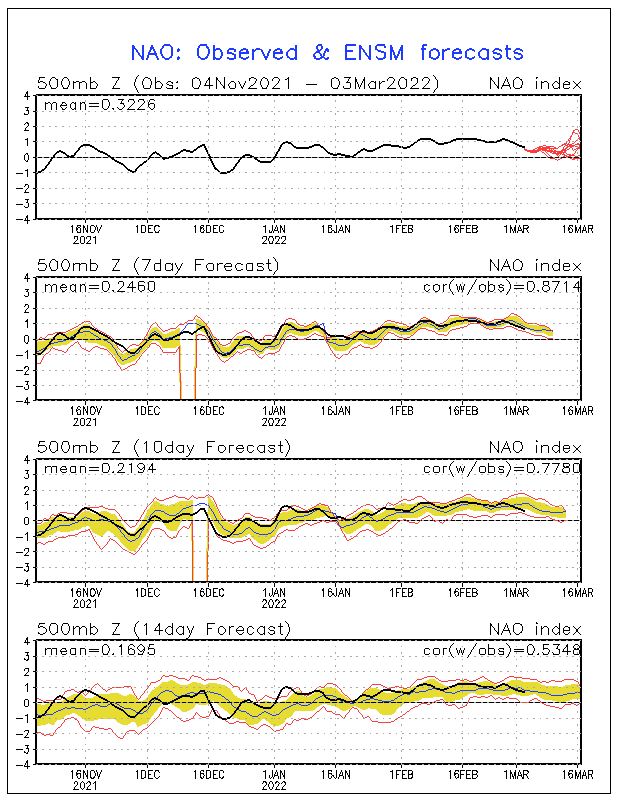
That's good new because as you all know we need the rain. At the same time, folks are reminded to slow down and drive with greater distance between cars, to prevent accidents.
These car "accidents" are a strange thing. Why? Well, we have had (but not recently) an unfortunate number of accidents that were not accidents at all, the last one left two children severely injured, and happened on the road outside my town when a Palestinian driver ran them over. More recently, a young man (Israel Arab) crashed his speeding car into a family, killing the mother and her three week old baby. One wonders, if this was also a terrorist attack.
We don't really know if the last was or was not a terrorist attack, but the result was the same. When a terrorist kills someone, the secret service, police, and army are mobilized to find the person or persons responsible. Yet, when someone kills someone in an "accident' on the road, that person just becomes another statistic (both the dead and undead). Yet, over the last several years, if not decade, more than 3000 Israelis were killed in road accidents, while 146 died in terrorist attacks (https://www.jewishvirtuallibrary.org/number-of-terrorism-fatalities-in-israel). That is more than 20 times the number of people killed by fellow Israelis than killed by our Palestinian neighbors! Are drivers who drive without concern for their fellow drivers not just as bad? Aren't they Road Terrorists?
If you don't want to be a road terrorist, then do the following: i) leave 1 car length between you and the car in front of you for every 15 km/h, ii) slow down when it's raining, iii) keep your eyes on the road. Don't i) pass on the right lane or in a left turning lane, ii) text while driving, iii) read your phone or dial your phone, iv) weave in and out, v) tailgate. (See, for example: https://www.safety.com/interstate-safety-tips/ ; https://www.bceo.org/safedrivingtips.html).
I'd also like to suggest that our police stop standing on corners and at stoplights to give out tickets, and get out on the roads, where dangerous driving occurs.
In summary be courteous of other drivers; don't be a road terrorist.
Barry Lynn
Wednesday, November 27, 2019
Weather It Is (Winter Is Coming!)
Good Evening:
Headlines are ringing: winter is coming!
But, first I must digress and explain how is it that I ended up with the responsibility to bring winter weather to Israel (i.e., bring the the rain at the right time and place). Basically, at the end of the 18 Blessing Prayer there is a place for personal prayers. At that time, I respectively pointed out that folks have been complaining to me for years about the weather, which isn't at all fair because I don't have much to do with it at all (at least not more than anyone else). This year, it was especially bad because here it seemed to stay warm for far too long, while other places were having normal or even colder weather than usual (in fact, a good part of the US is being blanketed in heavy snow, and even hurricane force winds (https://www.nytimes.com/2019/11/27/us/thanksgiving-weather.html?)). It was then that the fog lifted, my "prayers" hit home and I was given responsibility for this winters weather.
As I wrote, winter is coming and the last evening of the month will see the warmest temperatures for quite some time. In fact, I was able to arrange for a steady decline in temperatures from the start of December(Sunday) until the end of next week, and possibly into the following week (there is only so much cold air to go around, and I have to pay for it). Moreover, the end of next week and the following week could see persistent showers. I say "could see" because I'm not very good at multitasking and I have to first get the cold down before going on to bring the rain.
All this will be made possible by a shifting of the upper air pattern over Europe and the eastern Mediterranean. After a small ridge of warm air builds over our area on Shabbat, the pattern will split with one area of cold air moving southward along the western coast of Europe and another will drop down into our area. In between, an amplified ridge will build into central Europe.
This is a bit unusual, as relatively warm weather will remain at the time over Greenland, which usually ends up pushing the trough of cold air over western or central Europe, leaving us on the warmer side of the weather, where we've been for the last month. Fortunately, the warm air over Greenland should dissipate as we move towards the middle of the month, which should allow colder air to flow across Europe. This should open the door for cold air to slide southward into the eastern Mediterranean. It's a lot on my plate, but if all goes well, winter will be here.
By the way, the system arriving at the end of next week could be downright chilly, not just wet, but the kind of chill that makes you want to button up and possibly put on a hat. That's winter in Israel.
That's the winter my wife remembers when she was a child, but it came in October.
I am not sure if my wife really knew what she was signing up for when she agreed to marry me. People calling at all hours of the night to find out if they'll be able to get out in the morning, after a night of ice and snow. I can't tell you how many times we've had to wake up for just such phonecalls.
She should have been prepared, but it wasn't one of the questions she thought to ask about when we met ("do people call you at night?"). Instead, we spoke about some of our goals, some of our likes and dislikes, and technical things: would we be okay with internet or TV in the house, and would I make a mess in the kitchen -- important subjects for sure.
I thought that I had covered all the bases, and overall I think I made the right choice to marry my wife. Hence, you can imagine my surprise, which was followed by shock and consternation when I saw her prepare a peanut butter and chocolate sandwich for my son's breakfast.
She -- I almost feel like this is not something that should be in a blog -- she put the peanut butter on one slice of bread and the chocolate on the other. That is not a peanut butter and chocolate sandwich!
That's like two people marrying and never sleeping in the same bed (at the same time). You can't make a peanut butter and chocolate sandwich that way, and you can't grow watermelons either.
Barry Lynn
Headlines are ringing: winter is coming!
But, first I must digress and explain how is it that I ended up with the responsibility to bring winter weather to Israel (i.e., bring the the rain at the right time and place). Basically, at the end of the 18 Blessing Prayer there is a place for personal prayers. At that time, I respectively pointed out that folks have been complaining to me for years about the weather, which isn't at all fair because I don't have much to do with it at all (at least not more than anyone else). This year, it was especially bad because here it seemed to stay warm for far too long, while other places were having normal or even colder weather than usual (in fact, a good part of the US is being blanketed in heavy snow, and even hurricane force winds (https://www.nytimes.com/2019/11/27/us/thanksgiving-weather.html?)). It was then that the fog lifted, my "prayers" hit home and I was given responsibility for this winters weather.
As I wrote, winter is coming and the last evening of the month will see the warmest temperatures for quite some time. In fact, I was able to arrange for a steady decline in temperatures from the start of December(Sunday) until the end of next week, and possibly into the following week (there is only so much cold air to go around, and I have to pay for it). Moreover, the end of next week and the following week could see persistent showers. I say "could see" because I'm not very good at multitasking and I have to first get the cold down before going on to bring the rain.
All this will be made possible by a shifting of the upper air pattern over Europe and the eastern Mediterranean. After a small ridge of warm air builds over our area on Shabbat, the pattern will split with one area of cold air moving southward along the western coast of Europe and another will drop down into our area. In between, an amplified ridge will build into central Europe.
This is a bit unusual, as relatively warm weather will remain at the time over Greenland, which usually ends up pushing the trough of cold air over western or central Europe, leaving us on the warmer side of the weather, where we've been for the last month. Fortunately, the warm air over Greenland should dissipate as we move towards the middle of the month, which should allow colder air to flow across Europe. This should open the door for cold air to slide southward into the eastern Mediterranean. It's a lot on my plate, but if all goes well, winter will be here.
By the way, the system arriving at the end of next week could be downright chilly, not just wet, but the kind of chill that makes you want to button up and possibly put on a hat. That's winter in Israel.
That's the winter my wife remembers when she was a child, but it came in October.
I am not sure if my wife really knew what she was signing up for when she agreed to marry me. People calling at all hours of the night to find out if they'll be able to get out in the morning, after a night of ice and snow. I can't tell you how many times we've had to wake up for just such phonecalls.
She should have been prepared, but it wasn't one of the questions she thought to ask about when we met ("do people call you at night?"). Instead, we spoke about some of our goals, some of our likes and dislikes, and technical things: would we be okay with internet or TV in the house, and would I make a mess in the kitchen -- important subjects for sure.
I thought that I had covered all the bases, and overall I think I made the right choice to marry my wife. Hence, you can imagine my surprise, which was followed by shock and consternation when I saw her prepare a peanut butter and chocolate sandwich for my son's breakfast.
She -- I almost feel like this is not something that should be in a blog -- she put the peanut butter on one slice of bread and the chocolate on the other. That is not a peanut butter and chocolate sandwich!
That's like two people marrying and never sleeping in the same bed (at the same time). You can't make a peanut butter and chocolate sandwich that way, and you can't grow watermelons either.
Barry Lynn
Subscribe to:
Posts (Atom)