Good Afternoon:
Extreme Heat Likely! Danger to Life!
High pressure will build out of Africa over the next several days. The high pressure area is part of a broader ridge of warm air stretching into northwestern Europe. A stalled low pressure area over Spain embedded in the ridge will help to draw the high pressure area unusually northward, bringing with it desert heat. Based on global ensemble forecasts. there is a very high probability of extreme heat.
Northeasterly winds will exacerbate the heat as air descends over the mountains into the inland and coastal valleys.
The heat will increase throughout the week, before reaching a peak most likely on Sunday. Temperatures will reach the upper 30s to near 40 in the mountain areas, and 40 to just above 40 in the inland valleys. Areas close to the coast will see temperatures in the mid to upper 30s, with higher humidity (and higher heat indexes).
The heat will slowly dissipate as next week pushes along. However, there is a 50% chance that next week will end with temperatures again near 40 Celcius again.
Our rather tranquil, cool, and occasionally rainy weather has come to an end, and we our now in the period before summer when heat extremes are more likely than at other times of the spring/summer seasons.
Barry Lynn

Tuesday, May 12, 2020


Friday, May 8, 2020
Weather Forecasts (be Skeptical, but don't be a Skeptic)
Good Morning;
Updated Sunday morning May 10th.
The other day my wife asked me about why I wrote about her changing her wardrobe from winter to summer. "Why do people need to know about me changing my wardrobe?"
It's a good question that I have been pondering ever since. It's one of the reasons I haven't been doing much else, and have had trouble spending enough time to revise a research paper I am working on. I also growled at the cat, and complained about the mess in the house. It's one of the reasons that my last Thursday seemed to last forever. Such was the confusion about the time and day of the week that I may have been directly responsible for my wife waking up that night and asking: "is it still Shabbat?" To make matters worse, this morning she complained that she couldn't get out of bed because I forgot to tell her whether it would be winter or spring, so she didn't know what to wear. All because I wrote about her changing her wardrobe.
It should be pretty clear to the reader of this blog that my wife never pays any attention to my weather forecasts, which are readily available on the web. Had she, she would have noted that we were predicting the recent "winterstorm" in springtime more than a week in advance. Fortunately, she was able to scrounge some winter clothes, so she survived the storm in good health (Thank God) and good spirits -- until this morning when she didn't know what to wear. Of course, she chose spring clothing, and had to later change back to winter.
The weather can change quickly at this time of year, which adds to uncertainty in the forecast. Still, the next two weeks look like spring will have finally sprung, with many days being warm and sunny, and by the time I write my next blog it will most likely be oppressively hot!
Yet, even when the global forecast looks to be certain (meaning the model ensemble shows a high probability of a weather event -- or not), one should always have a bit of skepticism. Weather models have certain set grid spacings between forecast points, and various physical processes represented in the models are based on assumptions that can over time lead to unrealistic forecasts (model errors). A good dose of skepticism is required in order to minimize the chance of being caught by surprise.
Skepticism is defined as doubt about the truth of something. Just type in "Define skepticism" and you'll find things like "what is the goal of skepticism," "what is the importance of skepticism," and "what is the role of skepticism in science?"
Perhaps quite important to the following discussion: "is skepticism an emotion?"
Skepticism can be a good thing. It can challenge prevailing theories, reinterpreting the facts to develop a new, better theory. For instance, Daniel Kahneman working with Amos Tversky (https://en.wikipedia.org/wiki/Daniel_Kahneman) both developed a rigorous way to study human errors that arise from heuristics and biases (simple strategies we use to cope with events and how our preconceptions affect our responses to them).
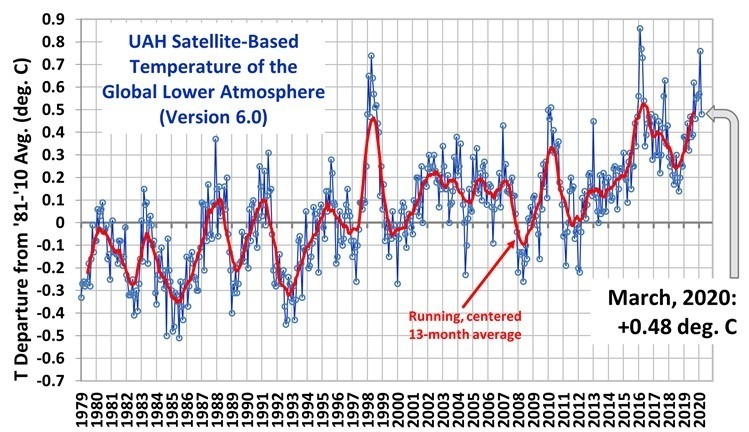
There is also a vocal group (including some scientists) who are skeptical about global predictions. At this point, we can say that the world has warmed in the last 50 years, but not as much as predicted by most of the climate forecast models. For instance, this page shows a warming of about 0.5 degrees above the average of the last 50 years (https://www.drroyspencer.com/wp-content/uploads/UAH_LT_1979_thru_March_2020_v6.jpg), which is about 1 degrees Celcius above the coldest temperatures within this period. However, average warming predictions were for about 0.8 Celcius by this time (https://www.ipcc.ch/sr15/graphics/), and about 90% of the forecasts were warmer than the observed warming. One might indeed wonder where are we going when it snows in May in New York City (Saturday morning), the coldest May 6th since 1891. How this should affect our economic and social policy going forward is something that should be considered. It is important to consider skeptical argument, and rebut it if possible. For instance, we will have an additional 0.3 Celcius warming just in the next decade if we continue along our current trend. Is that a large and important change, even though smaller than the vast majority of forecasts?
But, then there are what we will call "Skeptics." One might think that these practice emotional skepticism, trying to influence others through the use of emotional rhetoric. But, an emotional skeptic actually involves being aware of how easily emotions, strong passions, and convictions, can influence our response to stimuli in ways that may not be for our best interest.
Rather, I am calling a "Skeptic" as someone whose worldview informs his/her interpretation of the facts rather than facts informing his/her worldview. Usually, these types of people will base their opinion on other "Skeptics," in a reinforcing circle of delusion.
This is most pertinent to our policy related to coronavirus.
A Skeptic will say that the coronavirus is not so bad, no worse than a bad flu, and the policy of social distancing, shutting businesses has been a mistake - a colossal waste of money. Yet, both left (e.g, The New York Times) and right (e.g, the Wall Street Journal) newspapers have been reporting the perils of this pandemic. For instance, the WSJ reported that those who have been more susceptible to the virus have felt that the virus was akin to the "invasion of the body snatchers," (https://www.wsj.com/articles/coronavirus-hijacks-the-body-from-head-to-toe-perplexing-doctors-11588864248?mod=hp_lead_pos5). Moreover, Skeptics argue that the Pandemic is not really a pandemic or that hospitals were not really overwhelmed with patients. Yet, the NYTs has reported that there is no space to store the dead (https://www.nytimes.com/2020/04/30/nyregion/coronavirus-nyc-funeral-home-morgue-bodies.html) and that the death rate (death per unit time) has increased by more than 50% in many countries (https://www.nytimes.com/interactive/2020/04/21/world/coronavirus-missing-deaths.html), and even increased six times in New York City (https://www.nytimes.com/interactive/2020/04/27/upshot/coronavirus-deaths-new-york-city.html). See also: Doctors are fed up with conspiracies ravaging ERsHealth care professionals are dealing with a flurry of misinformation and harassment from conspiracy theorists, some of whom press doctors for proof of the virus's severity.'What are we doing this for?'
Another supposition is that a person just needs to develop antibodies against the virus. Yet, it is not at all clear that these antibodies or even all antibodies will protect against the virus (https://www.wsj.com/articles/among-new-coronavirus-antibody-tests-limited-value-and-many-unknowns-11588877202?mod=hp_lead_pos6). Moreover, as noted, many of the testing kits are not reliable.
Lastly, there is the idea of "herd immunity." Herd immunity is the idea that when enough people become immune that the disease spreads at a lower rate than at first encounter with people (or animals), perhaps even disappearing: (https://www.healthline.com/health/herd-immunity). For a good review, see here: https://www.discovermagazine.com/health/is-herd-immunity-our-best-weapon-against-covid-19.
Yet, herd immunity doesn't really work to protect us against the ravages of disease. That is why we need vaccines for measles, polio, mumps, etc. There are always new people being born, and there are always some who can infect the uninfected, or whose immunity has worn off. Moreover, the achievement of general immunity can come at a tremendous cost.
Here are some Skeptics to be aware of and why.
"The Failure of Expert Opinion" https://mail.google.com/mail/u/0/#inbox/FMfcgxwHNMRZTdsdxBBdtVtgQGFHZtDw?projector=1 Here, the person admits he doesn't understand basic concepts about the virus. He is not a medical or biological expert. He claims that if the infection rate is really like the flu, then we have nothing to worry about. Yet, he overlooks the fact that this is the percentage of people infected, rather than the population as whole -- many of whom have been vaccinated. Yet, there is no vaccine for Coronavirus.
The second shows a speaker (a doctor) who claims to be one of many physicians who believe that social distancing doesn't work (https://www.facebook.com/mari.barke/videos/10223167578641076/). You can tell these are true Skeptics because they denigrate those who believe otherwise by claiming they are "experts" and "mainstream media." Such ideas run counter to common sense, and counter to the experience of countries that practiced social distancing earlier compared to later (e.g., compare Israel and Belgium, or even Great Britain).
Then we have a long presentation from an epidemiologist who claims that we have reached a peak (https://www.worldometers.info/coronavirus/country/us/. Speaking about a peak implies that the number of new infections and deaths are moving downwards, or will soon will be, so we should immediately open the economy, without restriction. However, a plateau suggests otherwise. It actually implies an increasing number of total deaths (https://covid19.healthdata.org/united-states-of-america); these projections imply that the length of stay on the plateau and how many deaths will depend on how people behave and observe social distancing in the coming months. There are other questionable assumptions, like counting on herd immunity, which are used to support the most likely incorrect conclusions of the investigator.
Ironically, many of the arguments about the effectiveness of social distancing overlook the fact there have (most likely been) lower death (and death rates) than projected because of social distancing itself! After all, one might just say that vaccines don't work because there are very few deaths from Measles, Chicken Pox, and Polio.
By the way, Small Pox is supposedly extinct, but this happened not because of herd immunity developing because of the disease, but because of the vaccine against small pox itself.
The irony is that the Skeptics are correct to worry about the effect of economic and social policy on the state of the economy. However, if you want to be heard and you want to heard in a serious way, it is first necessary to admit that there is a problem to be addressed.
Shabbat Shalom (and now Shavua Tov!)
Barry Lynn
Updated Sunday morning May 10th.
The other day my wife asked me about why I wrote about her changing her wardrobe from winter to summer. "Why do people need to know about me changing my wardrobe?"
It's a good question that I have been pondering ever since. It's one of the reasons I haven't been doing much else, and have had trouble spending enough time to revise a research paper I am working on. I also growled at the cat, and complained about the mess in the house. It's one of the reasons that my last Thursday seemed to last forever. Such was the confusion about the time and day of the week that I may have been directly responsible for my wife waking up that night and asking: "is it still Shabbat?" To make matters worse, this morning she complained that she couldn't get out of bed because I forgot to tell her whether it would be winter or spring, so she didn't know what to wear. All because I wrote about her changing her wardrobe.
It should be pretty clear to the reader of this blog that my wife never pays any attention to my weather forecasts, which are readily available on the web. Had she, she would have noted that we were predicting the recent "winterstorm" in springtime more than a week in advance. Fortunately, she was able to scrounge some winter clothes, so she survived the storm in good health (Thank God) and good spirits -- until this morning when she didn't know what to wear. Of course, she chose spring clothing, and had to later change back to winter.
The weather can change quickly at this time of year, which adds to uncertainty in the forecast. Still, the next two weeks look like spring will have finally sprung, with many days being warm and sunny, and by the time I write my next blog it will most likely be oppressively hot!
Yet, even when the global forecast looks to be certain (meaning the model ensemble shows a high probability of a weather event -- or not), one should always have a bit of skepticism. Weather models have certain set grid spacings between forecast points, and various physical processes represented in the models are based on assumptions that can over time lead to unrealistic forecasts (model errors). A good dose of skepticism is required in order to minimize the chance of being caught by surprise.
Skepticism is defined as doubt about the truth of something. Just type in "Define skepticism" and you'll find things like "what is the goal of skepticism," "what is the importance of skepticism," and "what is the role of skepticism in science?"
Perhaps quite important to the following discussion: "is skepticism an emotion?"
Skepticism can be a good thing. It can challenge prevailing theories, reinterpreting the facts to develop a new, better theory. For instance, Daniel Kahneman working with Amos Tversky (https://en.wikipedia.org/wiki/Daniel_Kahneman) both developed a rigorous way to study human errors that arise from heuristics and biases (simple strategies we use to cope with events and how our preconceptions affect our responses to them).
There is also a vocal group (including some scientists) who are skeptical about global predictions. At this point, we can say that the world has warmed in the last 50 years, but not as much as predicted by most of the climate forecast models. For instance, this page shows a warming of about 0.5 degrees above the average of the last 50 years (https://www.drroyspencer.com/wp-content/uploads/UAH_LT_1979_thru_March_2020_v6.jpg), which is about 1 degrees Celcius above the coldest temperatures within this period. However, average warming predictions were for about 0.8 Celcius by this time (https://www.ipcc.ch/sr15/graphics/), and about 90% of the forecasts were warmer than the observed warming. One might indeed wonder where are we going when it snows in May in New York City (Saturday morning), the coldest May 6th since 1891. How this should affect our economic and social policy going forward is something that should be considered. It is important to consider skeptical argument, and rebut it if possible. For instance, we will have an additional 0.3 Celcius warming just in the next decade if we continue along our current trend. Is that a large and important change, even though smaller than the vast majority of forecasts?
But, then there are what we will call "Skeptics." One might think that these practice emotional skepticism, trying to influence others through the use of emotional rhetoric. But, an emotional skeptic actually involves being aware of how easily emotions, strong passions, and convictions, can influence our response to stimuli in ways that may not be for our best interest.
Rather, I am calling a "Skeptic" as someone whose worldview informs his/her interpretation of the facts rather than facts informing his/her worldview. Usually, these types of people will base their opinion on other "Skeptics," in a reinforcing circle of delusion.
This is most pertinent to our policy related to coronavirus.
A Skeptic will say that the coronavirus is not so bad, no worse than a bad flu, and the policy of social distancing, shutting businesses has been a mistake - a colossal waste of money. Yet, both left (e.g, The New York Times) and right (e.g, the Wall Street Journal) newspapers have been reporting the perils of this pandemic. For instance, the WSJ reported that those who have been more susceptible to the virus have felt that the virus was akin to the "invasion of the body snatchers," (https://www.wsj.com/articles/coronavirus-hijacks-the-body-from-head-to-toe-perplexing-doctors-11588864248?mod=hp_lead_pos5). Moreover, Skeptics argue that the Pandemic is not really a pandemic or that hospitals were not really overwhelmed with patients. Yet, the NYTs has reported that there is no space to store the dead (https://www.nytimes.com/2020/04/30/nyregion/coronavirus-nyc-funeral-home-morgue-bodies.html) and that the death rate (death per unit time) has increased by more than 50% in many countries (https://www.nytimes.com/interactive/2020/04/21/world/coronavirus-missing-deaths.html), and even increased six times in New York City (https://www.nytimes.com/interactive/2020/04/27/upshot/coronavirus-deaths-new-york-city.html). See also: Doctors are fed up with conspiracies ravaging ERsHealth care professionals are dealing with a flurry of misinformation and harassment from conspiracy theorists, some of whom press doctors for proof of the virus's severity.'What are we doing this for?'
Another supposition is that a person just needs to develop antibodies against the virus. Yet, it is not at all clear that these antibodies or even all antibodies will protect against the virus (https://www.wsj.com/articles/among-new-coronavirus-antibody-tests-limited-value-and-many-unknowns-11588877202?mod=hp_lead_pos6). Moreover, as noted, many of the testing kits are not reliable.
Lastly, there is the idea of "herd immunity." Herd immunity is the idea that when enough people become immune that the disease spreads at a lower rate than at first encounter with people (or animals), perhaps even disappearing: (https://www.healthline.com/health/herd-immunity). For a good review, see here: https://www.discovermagazine.com/health/is-herd-immunity-our-best-weapon-against-covid-19.
Yet, herd immunity doesn't really work to protect us against the ravages of disease. That is why we need vaccines for measles, polio, mumps, etc. There are always new people being born, and there are always some who can infect the uninfected, or whose immunity has worn off. Moreover, the achievement of general immunity can come at a tremendous cost.
Here are some Skeptics to be aware of and why.
"The Failure of Expert Opinion" https://mail.google.com/mail/u/0/#inbox/FMfcgxwHNMRZTdsdxBBdtVtgQGFHZtDw?projector=1 Here, the person admits he doesn't understand basic concepts about the virus. He is not a medical or biological expert. He claims that if the infection rate is really like the flu, then we have nothing to worry about. Yet, he overlooks the fact that this is the percentage of people infected, rather than the population as whole -- many of whom have been vaccinated. Yet, there is no vaccine for Coronavirus.
The second shows a speaker (a doctor) who claims to be one of many physicians who believe that social distancing doesn't work (https://www.facebook.com/mari.barke/videos/10223167578641076/). You can tell these are true Skeptics because they denigrate those who believe otherwise by claiming they are "experts" and "mainstream media." Such ideas run counter to common sense, and counter to the experience of countries that practiced social distancing earlier compared to later (e.g., compare Israel and Belgium, or even Great Britain).
Then we have a long presentation from an epidemiologist who claims that we have reached a peak (https://www.worldometers.info/coronavirus/country/us/. Speaking about a peak implies that the number of new infections and deaths are moving downwards, or will soon will be, so we should immediately open the economy, without restriction. However, a plateau suggests otherwise. It actually implies an increasing number of total deaths (https://covid19.healthdata.org/united-states-of-america); these projections imply that the length of stay on the plateau and how many deaths will depend on how people behave and observe social distancing in the coming months. There are other questionable assumptions, like counting on herd immunity, which are used to support the most likely incorrect conclusions of the investigator.
Ironically, many of the arguments about the effectiveness of social distancing overlook the fact there have (most likely been) lower death (and death rates) than projected because of social distancing itself! After all, one might just say that vaccines don't work because there are very few deaths from Measles, Chicken Pox, and Polio.
By the way, Small Pox is supposedly extinct, but this happened not because of herd immunity developing because of the disease, but because of the vaccine against small pox itself.
The irony is that the Skeptics are correct to worry about the effect of economic and social policy on the state of the economy. However, if you want to be heard and you want to heard in a serious way, it is first necessary to admit that there is a problem to be addressed.
Shabbat Shalom (and now Shavua Tov!)
Barry Lynn
Sunday, April 26, 2020
Weather It Is (Moving On)
Good Afternoon:
My wife took out her winter clothes and exchanged them for her summer clothes. She says that she is fed up with this weather and refuses to take it anymore.
Yesterday was chilly, windy, and showery, and today is definitely chilly. But, the sun is shining, and it should keep doing so for the next few days, and temperatures should moderate as well. When we look into May, though, we see another increase in humidity and that perhaps another weak "winter" storm that will bring a chance of thunderstorms followed by showers.
Some of you have might have noticed the yellow tint to the sky prior to Friday's storm. Yes, that was the color of dust, and the rain that fell was not the "pure rain" we've heard about and written about in poems.
There is supposed good news making the rounds of the internet (and newspapers). For instance, the Wall Street Journal editorializes (https://www.wsj.com/articles/the-new-antibody-evidence-11587769490?) that the apparent greater spread of the disease means the mortality rate is lower than the 3 -- 4 % estimated by the WHO. For example, the apparent mortality rate in the US is about 5.5%. It's possible that it is 10 times lower. However, in places that have done hundreds of thousands of tests, the infection is about 1 to 12% (e.g., UAE, Israel, Germany, and Italy (highest)). This is far from 50% that would lower the mortality rate from 5% to 0.5 or even less.
There are those who argue that if more people are already infected than we think that we'll be able to open the economy sooner. However, even if 10% of the population is already infected, that still leaves the rest who could become infected. Already the overall number of deaths is about twice that of the flu (in the US) and hospitals were already overwhelmed with patients. The end result could be many times higher unless a vaccine is developed and/or people continue to practice safe(r) hygiene (wear a mask, gloves, and wash their hands!).
Unfortunately, there is further information concerning the possible moribundity of the Coronavirus for even patients in their late 30s (https://www.timesofisrael.com/coronavirus-causing-strokes-in-some-younger-patients-report/). Researchers have found that some patients in their late 30s, 40s, and 50 are dying of strokes, and that 4 % and 8% of patients in the 40s and 50s require hospilization. So, government officials need to think very carefully about how they open the economy and allow social interactions, even among younger people. Moreover, there is evidence that people can become infected more than once.
As Ronald Reagan was fond of saying: "Trust and Verify" (https://www.nytimes.com/1987/12/10/opinion/trust-but-verify.html). In this case, the government needs to test as many people as it can, people who have an inkling of feeling ill should stay home, and those who go out need to keep their distance from others. Then, the economy can hopefully be reopened wisely, while protecting the most vulnerable (older population).
One organization trying to implement safe practices is the Israel Defense Force. We dropped our daughter at the induction center in Jerusalem, and we were not allowed to stay, but waved goodbye from a distance. She like the other young women came with large suitcases stuffed with enough underwear to last a month (I wouldn't want to be that first pair worn, or even the second...). I left the drop-off zone feeling like I had forgotten something. I couldn't figure out what that might be, since I hadn't exactly "forgotten" my daughter as we drove away.
We look forward to seeing her again, but I have to admit that it wasn't easy to wave goodbye (even if only for a month). When I returned home, I put my oatmeal in the wrong bowl, and almost put milk in my orange juice. Looking at newly taken picture of her in her army uniform, I wondered if parents every really see their children as they seem themselves? Or, even as others see them?
If I had my druthers, parents would live with their kids (and vice versa), but this isn't very practical and perhaps not very healthy over the long term. Still, if we're all in Israel, you can only go so far in any direction. Besides: when I got into this business of raising kids it wasn't so she could always be the sweet child she is, but with the hope that she would grow up to be independent, wise, and a good parent herself. So, who is to complain?
My wife, actually. She sent me for an-other hearing test. For some time now, she's been complaining that I don't hear her. I was was agreement (what else could I say), so I went for the test. Much to my surprise, they said my hearing is pretty much like it was the last time she sent me -- not much change (not perfect, but certainly within the range of expected range of sounds at my age). She professes to be happy with the news, but I am not so sure. The strange thing is that I never complain that she doesn't hear me. I sometimes think that she doesn't listen to me, but that is a different kettle of fish (https://literarydevices.net/a-different-kettle-of-fish/) entirely!
Barry Lynn
My wife took out her winter clothes and exchanged them for her summer clothes. She says that she is fed up with this weather and refuses to take it anymore.
Yesterday was chilly, windy, and showery, and today is definitely chilly. But, the sun is shining, and it should keep doing so for the next few days, and temperatures should moderate as well. When we look into May, though, we see another increase in humidity and that perhaps another weak "winter" storm that will bring a chance of thunderstorms followed by showers.
Some of you have might have noticed the yellow tint to the sky prior to Friday's storm. Yes, that was the color of dust, and the rain that fell was not the "pure rain" we've heard about and written about in poems.
There is supposed good news making the rounds of the internet (and newspapers). For instance, the Wall Street Journal editorializes (https://www.wsj.com/articles/the-new-antibody-evidence-11587769490?) that the apparent greater spread of the disease means the mortality rate is lower than the 3 -- 4 % estimated by the WHO. For example, the apparent mortality rate in the US is about 5.5%. It's possible that it is 10 times lower. However, in places that have done hundreds of thousands of tests, the infection is about 1 to 12% (e.g., UAE, Israel, Germany, and Italy (highest)). This is far from 50% that would lower the mortality rate from 5% to 0.5 or even less.
There are those who argue that if more people are already infected than we think that we'll be able to open the economy sooner. However, even if 10% of the population is already infected, that still leaves the rest who could become infected. Already the overall number of deaths is about twice that of the flu (in the US) and hospitals were already overwhelmed with patients. The end result could be many times higher unless a vaccine is developed and/or people continue to practice safe(r) hygiene (wear a mask, gloves, and wash their hands!).
Unfortunately, there is further information concerning the possible moribundity of the Coronavirus for even patients in their late 30s (https://www.timesofisrael.com/coronavirus-causing-strokes-in-some-younger-patients-report/). Researchers have found that some patients in their late 30s, 40s, and 50 are dying of strokes, and that 4 % and 8% of patients in the 40s and 50s require hospilization. So, government officials need to think very carefully about how they open the economy and allow social interactions, even among younger people. Moreover, there is evidence that people can become infected more than once.
As Ronald Reagan was fond of saying: "Trust and Verify" (https://www.nytimes.com/1987/12/10/opinion/trust-but-verify.html). In this case, the government needs to test as many people as it can, people who have an inkling of feeling ill should stay home, and those who go out need to keep their distance from others. Then, the economy can hopefully be reopened wisely, while protecting the most vulnerable (older population).
One organization trying to implement safe practices is the Israel Defense Force. We dropped our daughter at the induction center in Jerusalem, and we were not allowed to stay, but waved goodbye from a distance. She like the other young women came with large suitcases stuffed with enough underwear to last a month (I wouldn't want to be that first pair worn, or even the second...). I left the drop-off zone feeling like I had forgotten something. I couldn't figure out what that might be, since I hadn't exactly "forgotten" my daughter as we drove away.
We look forward to seeing her again, but I have to admit that it wasn't easy to wave goodbye (even if only for a month). When I returned home, I put my oatmeal in the wrong bowl, and almost put milk in my orange juice. Looking at newly taken picture of her in her army uniform, I wondered if parents every really see their children as they seem themselves? Or, even as others see them?
If I had my druthers, parents would live with their kids (and vice versa), but this isn't very practical and perhaps not very healthy over the long term. Still, if we're all in Israel, you can only go so far in any direction. Besides: when I got into this business of raising kids it wasn't so she could always be the sweet child she is, but with the hope that she would grow up to be independent, wise, and a good parent herself. So, who is to complain?
My wife, actually. She sent me for an-other hearing test. For some time now, she's been complaining that I don't hear her. I was was agreement (what else could I say), so I went for the test. Much to my surprise, they said my hearing is pretty much like it was the last time she sent me -- not much change (not perfect, but certainly within the range of expected range of sounds at my age). She professes to be happy with the news, but I am not so sure. The strange thing is that I never complain that she doesn't hear me. I sometimes think that she doesn't listen to me, but that is a different kettle of fish (https://literarydevices.net/a-different-kettle-of-fish/) entirely!
Barry Lynn
Sunday, April 19, 2020
Weather It Is (The Perfect Challah Recipe)
Good Afternoon:
I am sure that everyone has gotten used to the beautiful weather. In fact, the beautiful weather will continue into late Wednesday. However, a cool front will pass through Wednesday night with the possibility of showers, and then an unusually strong winter-like storm is forecast to move southward Friday and Shabbat. This storm will bring a chill to the air and local showers, as well as the possibility of thunderstorm. Perhaps, the weather will be in the news once again.
While everyone is speaking about the Coronavirus, I'd like to bring to your attention a couple of other viruses that are worth mentioning. In fact, they have been with us for quite some time, and there doesn't seem to be a treatment or a vaccine for them.
The first is the virus of hatred. It's called Hatrovirus, and it's thousands of years old, but infected the local Arab inhabitants about 100 years ago. Some people call it "anti-semitism" or Jew hatred. For instance, there has been ongoing coordination between the Palestinian and Israeli governments to fight the pandemic (https://www.timesofisrael.com/un-praises-excellent-israeli-palestinian-cooperation-in-fight-against-pandemic/). Yet, the Palestinian Prime Minister still found the time to "blame the Jews' for the need to cooperate at all (https://www.timesofisrael.com/pa-dismisses-warnings-to-cease-virus-incitement-campaign-against-israel/). On the other side, Hamas found the time to build a new hospital -- oops, I mean they found time to build a very long attack tunnel (https://www.timesofisrael.com/israel-reveals-how-its-winning-the-battle-against-hamass-gaza-attack-tunnels/). Of course, if you set your priorities right, you'll be sure to ask the Israeli government for ventilators (https://www.timesofisrael.com/liveblog_entry/hamas-wants-ventilators-as-part-of-prisoner-swap-deal-report/)) so that tunnel builders can be tended to if needed.
The second is the virus of optimism. This OptoVirus appears to have infected the Israeli leadership (and even many Israelis) at the time of the Oslo Accords (1994), but returned even more virulently after the exit from Gaza. Most recently, Israel arranged for Qatar to again deliver money to Hamas for supposed dispersal to needy families (https://www.timesofisrael.com/in-first-since-virus-emerged-in-gaza-banks-deliver-qatari-grants-to-poor/). I assume that these are the folks who would be better at studying at university (if there was one) than building tunnels. In the meantime, watch out for this virus because it causes insanity (https://professorbuzzkill.com/einstein-insanity-qnq/).
On the other hand, if not for this optimistic nature, who would have thought that the Jewish people could have risen from the ashes of the Holocaust? Quite frankly, the Jewish people were "infected" with optimism back when they decided it was time to leave Egypt.
On a lighter note: while I am sure that there are many people who missed out on their Passover trips and outings, there was one benefit that should be mentioned. There was a complete lack of pressure to do something. You see, in Israel, we have only one day off a week, and for the religious there are actually no days off. This means that when there is an opportunity to go somewhere, we MUST go somewhere.
It felt relaxing to not to have this pressure to go somewhere. It reminds me of Sunday's off when I was a kid, where I could decide to do something if I wanted to do something.
In the past year, we've actually had three "Sundays Off," or actually three election days. Why don't we have Sunday off (other than because of religious concerns about copying the non-Jewish world's "day of rest")? Or, why don't we have at least one day off a month, i.e, the week of the new month? It's because the manufacturing association says that the economy (really they) will lose money. Hence, even though we just imagined that we just came out of Egypt again, we're still slaves to the powers that run our economy (and lever the government). Thus, even though we are now supposed to be free men (and women) in our own land, we are actually slaves of sorts.
Of course, I know that these days were also days of stress, and it was great to read that the government will be "opening up" the economy. Besides getting people back to work, this means that there will be more pollution and more noise, an unfortunate byproduct of an functioning economy. While there is still time, I suggest that you take a moment and listen to the quiet. You might find that the quiet is filled with song. In fact, this is a great opportunity for even those with a small voice, or even an off tune tweet to find a mate. People have written about a potential baby boom about nine months from now, but one shouldn't overlook all the new young men who just may find their feathered sweetheart -- whose voices would have been unheard of in usual circumstances. It would be like what would have happened had I never come to Israel -- no blog, but especially no kids. So, keep an eye out for those birds.
We just finished Passover, and we're on our way to Shavuot. I had a thought that Passover -- while a joyous holiday -- is supposed to instill in us a feeling of humility. We eat Matza, which is a "bread" baked before it can become leavened, or full of hot air -- or false pride. In contrast, on Shavuot, when we have received the Torah, which provides us with the rules to live our lives as both religious and good people. We have a "right" to feel puffed up, so we eat Challot.
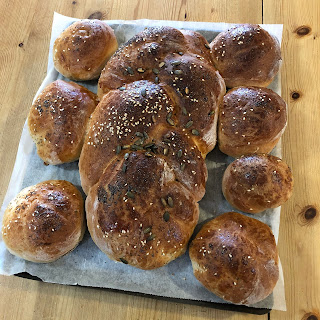
Here's a recipe for the Perfect Challah. It makes 1 Challah and 5 Challah Rolls. For a bread machine, add the ingredients in the order listed. For a mixer, add the yeast to the first 5 ingredients, and let sit for a few minutes to activate the yeast.
Here's a recipe for the Perfect Challah.
1) 1 1/3 cup water
2) 1/4 cup sugar
3) 1 Tb Honey
4) 2 Tb Canola Oil
5) 1 egg
6) 1 1/2 Tb Salt
7) 1 1/2 cups white flour
8) 1 cup whole wheat flour
9) 1 cup Spelt flour
10) 1 TB Gluten (or use high gluten white flour)
11) 2 1/2 tsp dry "instant yeast"
For a bread machine: add the first six ingredients, and the last ingredients afterwards on top.
Set to the dough setting, and let rise (around 1 1/2 hours total on the bread machine setting). When removing from the baking dish, use a bit of flour to prevent the dough from sticking to your hands.
For a mixer:
If you’ll be kneading in a mixer with a dough hook, combine wet and dry ingredients in separate bowls. Then add the wet ingredients to the mixer bowl on the bottom, followed by the dry ingredients. Operate the mixer with a dough hook, and start the timer when both wet and dry ingredients are combined. Knead with a dough hook for a maximum of 7 minutes, no more. The dough should be slightly stick. When removing the dough or kneading, coat hands with flour to keep the dough from sticking. If kneading by hand do not exceed 10 minutes. Let rise until double the size.
Continuing for both mixer and bread machine:
Divide into one large Challah and 5 rolls (about 2/3 & 1/3 of the dough). Brush with an egg mixed with oil, and sprinkle on toppings.
Heat your oven to a temperature that is ideal for yeast to propagate. This is about 90 degrees Fahrenheit or 30 degrees Celcius. Some say as much as 37 Celcius (97.8 Fahrenheit).
Let double in size again (about 30 minutes or so), and then cook at 180 Celcius for 30 minutes (in preheated oven).
To make more Challah than suggested (2 Challot and some rolls), add one more egg, 1/4 cup more liquid, and about 1 cup more flour. Check for consistency. The dough should be firm to the touch, but your finger should be able to indent it, without sticking to the dough.
I am sure that everyone has gotten used to the beautiful weather. In fact, the beautiful weather will continue into late Wednesday. However, a cool front will pass through Wednesday night with the possibility of showers, and then an unusually strong winter-like storm is forecast to move southward Friday and Shabbat. This storm will bring a chill to the air and local showers, as well as the possibility of thunderstorm. Perhaps, the weather will be in the news once again.
While everyone is speaking about the Coronavirus, I'd like to bring to your attention a couple of other viruses that are worth mentioning. In fact, they have been with us for quite some time, and there doesn't seem to be a treatment or a vaccine for them.
The first is the virus of hatred. It's called Hatrovirus, and it's thousands of years old, but infected the local Arab inhabitants about 100 years ago. Some people call it "anti-semitism" or Jew hatred. For instance, there has been ongoing coordination between the Palestinian and Israeli governments to fight the pandemic (https://www.timesofisrael.com/un-praises-excellent-israeli-palestinian-cooperation-in-fight-against-pandemic/). Yet, the Palestinian Prime Minister still found the time to "blame the Jews' for the need to cooperate at all (https://www.timesofisrael.com/pa-dismisses-warnings-to-cease-virus-incitement-campaign-against-israel/). On the other side, Hamas found the time to build a new hospital -- oops, I mean they found time to build a very long attack tunnel (https://www.timesofisrael.com/israel-reveals-how-its-winning-the-battle-against-hamass-gaza-attack-tunnels/). Of course, if you set your priorities right, you'll be sure to ask the Israeli government for ventilators (https://www.timesofisrael.com/liveblog_entry/hamas-wants-ventilators-as-part-of-prisoner-swap-deal-report/)) so that tunnel builders can be tended to if needed.
The second is the virus of optimism. This OptoVirus appears to have infected the Israeli leadership (and even many Israelis) at the time of the Oslo Accords (1994), but returned even more virulently after the exit from Gaza. Most recently, Israel arranged for Qatar to again deliver money to Hamas for supposed dispersal to needy families (https://www.timesofisrael.com/in-first-since-virus-emerged-in-gaza-banks-deliver-qatari-grants-to-poor/). I assume that these are the folks who would be better at studying at university (if there was one) than building tunnels. In the meantime, watch out for this virus because it causes insanity (https://professorbuzzkill.com/einstein-insanity-qnq/).
On the other hand, if not for this optimistic nature, who would have thought that the Jewish people could have risen from the ashes of the Holocaust? Quite frankly, the Jewish people were "infected" with optimism back when they decided it was time to leave Egypt.
On a lighter note: while I am sure that there are many people who missed out on their Passover trips and outings, there was one benefit that should be mentioned. There was a complete lack of pressure to do something. You see, in Israel, we have only one day off a week, and for the religious there are actually no days off. This means that when there is an opportunity to go somewhere, we MUST go somewhere.
It felt relaxing to not to have this pressure to go somewhere. It reminds me of Sunday's off when I was a kid, where I could decide to do something if I wanted to do something.
In the past year, we've actually had three "Sundays Off," or actually three election days. Why don't we have Sunday off (other than because of religious concerns about copying the non-Jewish world's "day of rest")? Or, why don't we have at least one day off a month, i.e, the week of the new month? It's because the manufacturing association says that the economy (really they) will lose money. Hence, even though we just imagined that we just came out of Egypt again, we're still slaves to the powers that run our economy (and lever the government). Thus, even though we are now supposed to be free men (and women) in our own land, we are actually slaves of sorts.
Of course, I know that these days were also days of stress, and it was great to read that the government will be "opening up" the economy. Besides getting people back to work, this means that there will be more pollution and more noise, an unfortunate byproduct of an functioning economy. While there is still time, I suggest that you take a moment and listen to the quiet. You might find that the quiet is filled with song. In fact, this is a great opportunity for even those with a small voice, or even an off tune tweet to find a mate. People have written about a potential baby boom about nine months from now, but one shouldn't overlook all the new young men who just may find their feathered sweetheart -- whose voices would have been unheard of in usual circumstances. It would be like what would have happened had I never come to Israel -- no blog, but especially no kids. So, keep an eye out for those birds.
We just finished Passover, and we're on our way to Shavuot. I had a thought that Passover -- while a joyous holiday -- is supposed to instill in us a feeling of humility. We eat Matza, which is a "bread" baked before it can become leavened, or full of hot air -- or false pride. In contrast, on Shavuot, when we have received the Torah, which provides us with the rules to live our lives as both religious and good people. We have a "right" to feel puffed up, so we eat Challot.
Here's a recipe for the Perfect Challah. It makes 1 Challah and 5 Challah Rolls. For a bread machine, add the ingredients in the order listed. For a mixer, add the yeast to the first 5 ingredients, and let sit for a few minutes to activate the yeast.
Here's a recipe for the Perfect Challah.
1) 1 1/3 cup water
2) 1/4 cup sugar
3) 1 Tb Honey
4) 2 Tb Canola Oil
5) 1 egg
6) 1 1/2 Tb Salt
7) 1 1/2 cups white flour
8) 1 cup whole wheat flour
9) 1 cup Spelt flour
10) 1 TB Gluten (or use high gluten white flour)
11) 2 1/2 tsp dry "instant yeast"
For a bread machine: add the first six ingredients, and the last ingredients afterwards on top.
Set to the dough setting, and let rise (around 1 1/2 hours total on the bread machine setting). When removing from the baking dish, use a bit of flour to prevent the dough from sticking to your hands.
For a mixer:
If you’ll be kneading in a mixer with a dough hook, combine wet and dry ingredients in separate bowls. Then add the wet ingredients to the mixer bowl on the bottom, followed by the dry ingredients. Operate the mixer with a dough hook, and start the timer when both wet and dry ingredients are combined. Knead with a dough hook for a maximum of 7 minutes, no more. The dough should be slightly stick. When removing the dough or kneading, coat hands with flour to keep the dough from sticking. If kneading by hand do not exceed 10 minutes. Let rise until double the size.
Continuing for both mixer and bread machine:
Divide into one large Challah and 5 rolls (about 2/3 & 1/3 of the dough). Brush with an egg mixed with oil, and sprinkle on toppings.
Heat your oven to a temperature that is ideal for yeast to propagate. This is about 90 degrees Fahrenheit or 30 degrees Celcius. Some say as much as 37 Celcius (97.8 Fahrenheit).
Let double in size again (about 30 minutes or so), and then cook at 180 Celcius for 30 minutes (in preheated oven).
To make more Challah than suggested (2 Challot and some rolls), add one more egg, 1/4 cup more liquid, and about 1 cup more flour. Check for consistency. The dough should be firm to the touch, but your finger should be able to indent it, without sticking to the dough.
Barry Lynn

Monday, April 13, 2020
Weather It Is (The Absolutely Best Passover Pancakes)
Good Morning:
After a very nice April rain, our weather has turned really nice. Temperatures will continue to moderate over the next week to 10 days, and with the exception of the end of this week when a few showers might dot the landscape, skies should be mostly sunny with light winds.
It will be perfect weather to head out to the parks and beaches, or take a long walk or bike ride.
Except we can't because we're not allowed.
Yet, I finally realized what makes this country great. People don't follow the rules -- especially if they feel they don't suit them. For instance, our Prime Minister (the one who is under indictment) invited his son (who does not live with him) to visit for his Passover Seder. Our Health! Minister went to pray in a Minyon (group), and our President invited family members to join him. Our previous Minster of Defense described the rules as stupid, so he also invited family members.
As they say, rules are made to be broken -- unless the police decide otherwise -- and sometimes rules or our "set ways" do need to be "bent" to accomplish an important goal or task in record time, for instance. Yet, there is something disconcerting about those who are telling us to stay home and who left their grand parents by themselves are themselves breaking the rules. Or, as the joke goes: the only one in jail is ourselves -- not our Prime Minister.
I too broke the rules: I changed the ingredients of a recipe I found for Pesach (Passover) pancakes, It is based on "Shalvie's Passover Pancakes." I use Matza Cake Meal instead of Matza Meal. I used sour milk instead of plain milk (leftover from making butter, but you can make it yourself by adding 1 Tablespoon lemon juice to milk). I added baking powder and sugar (instead of vanilla sugar). I omitted the chocolate chips. It make about 16 nice sized pancakes (after doubling some of the authors listed ingredients).
Ingredients
4 eggs
1 cup Matza Cake Meal.
1/2 cup almond meal
1 tsp baking powder (kosher for Pesach)
1 Heaping Tablespoon Sugar
1 teaspoon ground cinnamon
1/2 tsp salt
1 cup sour milk (or milk, if you prefer)
Directions
1. Beat Eggs until blended
2. Add rest of ingredients to eggs
3. Mix until smooth (with spoon)
4. Add margarine to pan.
5. Cook on medium heat until brown and bubbly; flip and cook to brown bottom side.
Eat and Enjoy!
Barry Lynn
After a very nice April rain, our weather has turned really nice. Temperatures will continue to moderate over the next week to 10 days, and with the exception of the end of this week when a few showers might dot the landscape, skies should be mostly sunny with light winds.
It will be perfect weather to head out to the parks and beaches, or take a long walk or bike ride.
Except we can't because we're not allowed.
Yet, I finally realized what makes this country great. People don't follow the rules -- especially if they feel they don't suit them. For instance, our Prime Minister (the one who is under indictment) invited his son (who does not live with him) to visit for his Passover Seder. Our Health! Minister went to pray in a Minyon (group), and our President invited family members to join him. Our previous Minster of Defense described the rules as stupid, so he also invited family members.
As they say, rules are made to be broken -- unless the police decide otherwise -- and sometimes rules or our "set ways" do need to be "bent" to accomplish an important goal or task in record time, for instance. Yet, there is something disconcerting about those who are telling us to stay home and who left their grand parents by themselves are themselves breaking the rules. Or, as the joke goes: the only one in jail is ourselves -- not our Prime Minister.
I too broke the rules: I changed the ingredients of a recipe I found for Pesach (Passover) pancakes, It is based on "Shalvie's Passover Pancakes." I use Matza Cake Meal instead of Matza Meal. I used sour milk instead of plain milk (leftover from making butter, but you can make it yourself by adding 1 Tablespoon lemon juice to milk). I added baking powder and sugar (instead of vanilla sugar). I omitted the chocolate chips. It make about 16 nice sized pancakes (after doubling some of the authors listed ingredients).
Ingredients
4 eggs
1 cup Matza Cake Meal.
1/2 cup almond meal
1 tsp baking powder (kosher for Pesach)
1 Heaping Tablespoon Sugar
1 teaspoon ground cinnamon
1/2 tsp salt
1 cup sour milk (or milk, if you prefer)
Directions
1. Beat Eggs until blended
2. Add rest of ingredients to eggs
3. Mix until smooth (with spoon)
4. Add margarine to pan.
5. Cook on medium heat until brown and bubbly; flip and cook to brown bottom side.
Eat and Enjoy!
Barry Lynn
Tuesday, March 31, 2020
Weather It Is (Big Weather Swings)
Good Evening:
We're expecting some big swings in our temperatures. A trough of low pressure will soon be replaced by a ridge of high pressure, which will build into our area on Friday.
The Global Ensemble Forecast (GEFS) indicates a high certainty of unseasonably hot weather. Our local weather model indicates that temperature should peak from the lower 30s (central mountain areas) to upper 30s along the coast, and normally hotter desert areas.
The heat will be short-lived, though, as Monday should be substantially cooler as a trough of lower pressure returns. The seven days of Peach should have moderate temperatures with local showers. Moisture will be present at lower and upper levels, but humidity levels in the middle atmosphere will not be high enough to bring any prolonged heavy rain.
It's some big swings in our temperatures, and residents are advised to be sure that their air conditioners are in working order -- as the heat will be intense in some areas.
It's fortunate that I am keeping track of the weather. Since I became home-bound with the rest of you, I have trouble remembering the days of the week. Now, since the clock changed, I can't seem to figure out what hour it is.
I read an article in the Jerusalem Post the other day entitled "Back to Work." The authors tried to tell us that the Coronavirus is really not much to worry about, while falsely referring to a much lower mortality rate than the apparent mortality rate. One can argue that we don't really know of all those that are sick, so therefore we don't really know the mortality rate, but try telling that to a emergency room doctor in NYC, where hospitals are overrun with patients (https://www.nytimes.com/2020/03/29/nyregion/coronavirus-new-york-update.html?). Simply, the CoronaVirus is terrible contagious and has made even younger people very sick (or worse).
One of the points of the article was that there is a cost to closing the economy that is yet (mostly) uncounted, and this is true. However, in order to calculate whether to open the economy one needs to weigh the risks to health and life against the other costs. This should be done -- and targeted openings should be considered -- but only by those who actually recognise the severity of the disease.
To sum up: there are those who hate "big government," and government regulations, but as the United States has clearly shown, too little government and too little planning is simply too little government too late (https://www.nytimes.com/2020/03/29/business/coronavirus-us-ventilator-shortage.html? https://www.nytimes.com/2020/03/28/us/testing-coronavirus-pandemic.html?).''
One last thing to note: hand washing, wearing gloves while shopping, etc, and covering your face have been recently shown to be the best protection of all (https://www.nytimes.com/2020/03/27/health/us-coronavirus-face-masks.html).
Barry Lynn
We're expecting some big swings in our temperatures. A trough of low pressure will soon be replaced by a ridge of high pressure, which will build into our area on Friday.
The Global Ensemble Forecast (GEFS) indicates a high certainty of unseasonably hot weather. Our local weather model indicates that temperature should peak from the lower 30s (central mountain areas) to upper 30s along the coast, and normally hotter desert areas.
The heat will be short-lived, though, as Monday should be substantially cooler as a trough of lower pressure returns. The seven days of Peach should have moderate temperatures with local showers. Moisture will be present at lower and upper levels, but humidity levels in the middle atmosphere will not be high enough to bring any prolonged heavy rain.
It's some big swings in our temperatures, and residents are advised to be sure that their air conditioners are in working order -- as the heat will be intense in some areas.
It's fortunate that I am keeping track of the weather. Since I became home-bound with the rest of you, I have trouble remembering the days of the week. Now, since the clock changed, I can't seem to figure out what hour it is.
I read an article in the Jerusalem Post the other day entitled "Back to Work." The authors tried to tell us that the Coronavirus is really not much to worry about, while falsely referring to a much lower mortality rate than the apparent mortality rate. One can argue that we don't really know of all those that are sick, so therefore we don't really know the mortality rate, but try telling that to a emergency room doctor in NYC, where hospitals are overrun with patients (https://www.nytimes.com/2020/03/29/nyregion/coronavirus-new-york-update.html?). Simply, the CoronaVirus is terrible contagious and has made even younger people very sick (or worse).
One of the points of the article was that there is a cost to closing the economy that is yet (mostly) uncounted, and this is true. However, in order to calculate whether to open the economy one needs to weigh the risks to health and life against the other costs. This should be done -- and targeted openings should be considered -- but only by those who actually recognise the severity of the disease.
To sum up: there are those who hate "big government," and government regulations, but as the United States has clearly shown, too little government and too little planning is simply too little government too late (https://www.nytimes.com/2020/03/29/business/coronavirus-us-ventilator-shortage.html? https://www.nytimes.com/2020/03/28/us/testing-coronavirus-pandemic.html?).''
One last thing to note: hand washing, wearing gloves while shopping, etc, and covering your face have been recently shown to be the best protection of all (https://www.nytimes.com/2020/03/27/health/us-coronavirus-face-masks.html).
Barry Lynn
Tuesday, March 24, 2020
Weather It Is (Severe Storms On the Horizon)
Good Morning/Early Afternoon:
Highlights: Alternating days of warmth and chill, followed by end of the week severe storms.
We're a few days past our last storm, which brought unusually cold weather to most of the country. Precipitation fell steadily late date into Shabbat, with rain mixing with snow late Friday night in the higher elevations of the central and northern mountains. It was, alas, fleeting, unlike our winter rains.
Our next storm should arrive either Thursday or Friday, with a sharp drop in temperatures (but not close to freezing like our last storm). It will be the result of a storm moving across northern Africa combining with a low of polar Origins moving southward past Italy. This will provide the storm with two ingredients: plenty of moisture from the Mediterranean and African dust as the storm makes its way past Cyprus.
Our previous storm moved across northern Africa, and subsequently left destruction across Egypt and flooding across southern Israel with greater than 100 km winds from south to north. This storm will take a more northerly track, and swing past Cyprus -- hence, coastal cities are more likely to see direct impacts from this storm, including strong winds, lightning/hail, and heavy rains.
There are still timing questions and the exact path of the storm is still not certain, so an update will be issued later in the week.
What is even more uncertain is what day of the week is it? I find myself thinking that Monday is Tuesday or some other day is another day that already passed. It's very difficult when one doesn't have a set schedule to remember what part of the week one is in.
While trying to figure out what day it is, I thought it worthwhile to review some numbers. Not too long ago, about 1 out of 70,000 Israelis were sick. Now it's officially one out of six thousand. For this reason, the government has instituted social distancing, which is more or less! being observed. One of the ideas was to limit group gatherings and now up to 10 people can pray in a Minyon. The thing is that the numbers we know of are probably an underestimation of the people sick because each infected person infects two to three people (https://www.sciencealert.com/the-new-coronavirus-isn-t-like-the-flu-but-they-have-one-big-thing-in-common), while in comparison the flu infects about half that number (https://www.livescience.com/new-coronavirus-compare-with-flu.html). Moreover, if 10 people get together, there is approximately a 1/100 to 1/1000 chance of one person getting sick, and since there are probably more than 1000 prayer groups in a day, there is a very good chance that at least 1 person will get sick and infect at least 2 to 3 others. So, a small chance for each of us can have a large eventual impact on all of us.
Ways to slow down (or even stop) the infection of others is to stay at home if you have symptoms (cough, sneezing, or sore throat) and wear a mask if you must go out; additionally wash your hands frequently and stay at least 2 meters from other people. You can also wear disposable gloves, but change these frequently, and don't touch your face! Don't think you are immune because your a teenager or still "young" (https://www.nytimes.com/2020/03/23/opinion/coronavirus-young-people.html?action=click&module=Opinion&pgtype=Homepage). Here is a website that sums up these suggestions (https://www.cdc.gov/coronavirus/2019-ncov/prepare/prevention.html).
Another way, is to have a wife who decides to make a shining example of a bath tub. So was she proud of her cleaning prowess that she required me to immediately supine within. We actually installed this tub a while ago, but I have to admit that my enthusiasm for baths does not compete with other time dependent obligations. So, after donning my best bathing suit, there I was supining and contemplating the time spent from my last bath and considering just where I was and where I came from.
I started with my toes. They still reach the end of the tub, meaning I haven't shrunk too much since I previously measured my length is such a way. I also noted that there were not too many grey hairs, which was reassuring. But, I also noted that it is hard to tell that my belly button is an "outie." Most people have an "innie," but for some reason I am not like most people. My mother said that the doctor who delivered me regularly gave all "his" children a different knot than other doctors, but I wonder if he was simply bored and decided that day and time to do something different.
Or, maybe he took one look at me and decided that this child might be a bit shy and would need something to speak about when normal conversation fails. Yet, I never found that discussing belly buttons was much of a conversation starter, but more like a conversation finisher, unless I was having a bath with one of my brothers. In fact, I gave it up as a topic of conversation by the time I met my wife and never mentioned it to her.
I still haven't, and I am not sure she every noticed. After all, one doesn't necessarily see what one doesn't expect, and childhood worries are best left in childhood.
Barry Lynn
Highlights: Alternating days of warmth and chill, followed by end of the week severe storms.
We're a few days past our last storm, which brought unusually cold weather to most of the country. Precipitation fell steadily late date into Shabbat, with rain mixing with snow late Friday night in the higher elevations of the central and northern mountains. It was, alas, fleeting, unlike our winter rains.
Our next storm should arrive either Thursday or Friday, with a sharp drop in temperatures (but not close to freezing like our last storm). It will be the result of a storm moving across northern Africa combining with a low of polar Origins moving southward past Italy. This will provide the storm with two ingredients: plenty of moisture from the Mediterranean and African dust as the storm makes its way past Cyprus.
Our previous storm moved across northern Africa, and subsequently left destruction across Egypt and flooding across southern Israel with greater than 100 km winds from south to north. This storm will take a more northerly track, and swing past Cyprus -- hence, coastal cities are more likely to see direct impacts from this storm, including strong winds, lightning/hail, and heavy rains.
There are still timing questions and the exact path of the storm is still not certain, so an update will be issued later in the week.
What is even more uncertain is what day of the week is it? I find myself thinking that Monday is Tuesday or some other day is another day that already passed. It's very difficult when one doesn't have a set schedule to remember what part of the week one is in.
While trying to figure out what day it is, I thought it worthwhile to review some numbers. Not too long ago, about 1 out of 70,000 Israelis were sick. Now it's officially one out of six thousand. For this reason, the government has instituted social distancing, which is more or less! being observed. One of the ideas was to limit group gatherings and now up to 10 people can pray in a Minyon. The thing is that the numbers we know of are probably an underestimation of the people sick because each infected person infects two to three people (https://www.sciencealert.com/the-new-coronavirus-isn-t-like-the-flu-but-they-have-one-big-thing-in-common), while in comparison the flu infects about half that number (https://www.livescience.com/new-coronavirus-compare-with-flu.html). Moreover, if 10 people get together, there is approximately a 1/100 to 1/1000 chance of one person getting sick, and since there are probably more than 1000 prayer groups in a day, there is a very good chance that at least 1 person will get sick and infect at least 2 to 3 others. So, a small chance for each of us can have a large eventual impact on all of us.
Ways to slow down (or even stop) the infection of others is to stay at home if you have symptoms (cough, sneezing, or sore throat) and wear a mask if you must go out; additionally wash your hands frequently and stay at least 2 meters from other people. You can also wear disposable gloves, but change these frequently, and don't touch your face! Don't think you are immune because your a teenager or still "young" (https://www.nytimes.com/2020/03/23/opinion/coronavirus-young-people.html?action=click&module=Opinion&pgtype=Homepage). Here is a website that sums up these suggestions (https://www.cdc.gov/coronavirus/2019-ncov/prepare/prevention.html).
Another way, is to have a wife who decides to make a shining example of a bath tub. So was she proud of her cleaning prowess that she required me to immediately supine within. We actually installed this tub a while ago, but I have to admit that my enthusiasm for baths does not compete with other time dependent obligations. So, after donning my best bathing suit, there I was supining and contemplating the time spent from my last bath and considering just where I was and where I came from.
I started with my toes. They still reach the end of the tub, meaning I haven't shrunk too much since I previously measured my length is such a way. I also noted that there were not too many grey hairs, which was reassuring. But, I also noted that it is hard to tell that my belly button is an "outie." Most people have an "innie," but for some reason I am not like most people. My mother said that the doctor who delivered me regularly gave all "his" children a different knot than other doctors, but I wonder if he was simply bored and decided that day and time to do something different.
Or, maybe he took one look at me and decided that this child might be a bit shy and would need something to speak about when normal conversation fails. Yet, I never found that discussing belly buttons was much of a conversation starter, but more like a conversation finisher, unless I was having a bath with one of my brothers. In fact, I gave it up as a topic of conversation by the time I met my wife and never mentioned it to her.
I still haven't, and I am not sure she every noticed. After all, one doesn't necessarily see what one doesn't expect, and childhood worries are best left in childhood.
Barry Lynn
Subscribe to:
Posts (Atom)